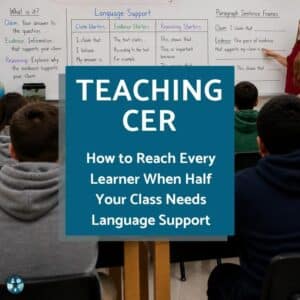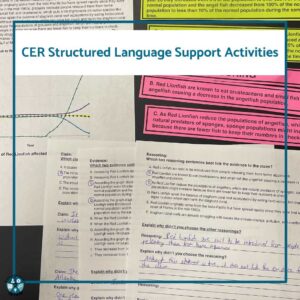

It was the Thursday after Thanksgiving break. We had already written more than 20 CER paragraphs since the beginning of the year. I had just spent the class period teaching CER with our first practice problem back from the break. We went through the problem, broke down the reading, analyzed the graphs, and recorded key evidence and reasoning points into a graphic organizer. Everything was right there on the page in front of them. All they had to do now was write their answer to the question. No problem, right?
But they just stared at their papers. Yes, a few students started writing, you know, your top A students, but the rest started to do anything but write. They were definitely in avoidance mode.
I have realized that this has been a pattern that has been happening every year for the last few years. No matter how much we had practiced, it was like they had never written a CER before in their lives.
Are you also seeing this? After seeing this pattern multiple times, always after a break, I decided I needed to be much more intentional about the progression I was using to get students from confusion to confidence.
Why students freeze (and what to do about it)
When students stare at a blank piece of paper after they have already done all the thinking work, it is usually not because they do not understand the science. It is because translating their thinking into the CER format is still not automatic. The format itself is taking up too much of their mental energy.
This is why scaffolding matters so much. Scaffolding is not doing the work for your students. It is building the ladder they need to eventually climb on their own, and then systematically removing it as they get stronger. The goal is always independence. But rushing toward independence before students are ready is exactly what causes those Thanksgiving-break deer-in-the-headlights moments. Sometimes you need to give a refresher before taking them to the next level.
I like to start on day 1 and connect this directly to the state test since I teach 8th grade. In our state, students will encounter around 20 CER questions on their science test that covers 6th, 7th, and 8th grade standards. I want them to see that we are not just practicing a classroom writing format, we are building a skill that shows up on the test, in their English class, in history, and anywhere they are asked to make a claim and support it with evidence. That bigger picture motivates them and gives the whole progression a sense of purpose from the very beginning.
Here is the four-stage scaffolding progression I use, and what it actually looks like in practice.
The four-stage scaffolding process
STAGE 1: SENTENCE CHOICE — IDENTIFYING THE PARTS BEFORE WRITING THEM
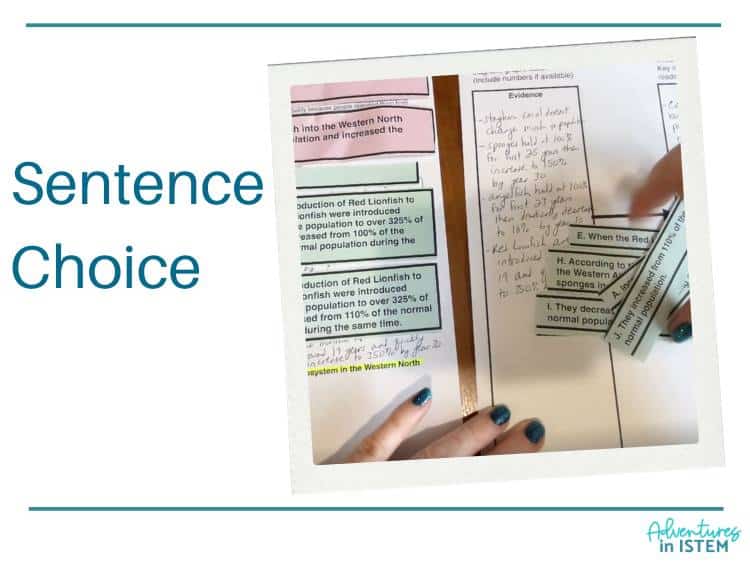
Before students can write a CER they have to be able to recognize one. This is where sentence choice comes in, and it is the stage most teachers skip, which is part of why students struggle later.
In this stage students are not writing anything yet. They are reading pre-written sentences and making decisions about them. Which of these four sentences best answers the question as a claim? Which two pieces of evidence from this list actually support that claim? Which sentence is the reasoning and not just a repeat of the evidence?
The first few times I do this, I cut the sentences into strips so students can physically hold and arrange the different pieces. There is something powerful about being able to pick up the evidence strip and place it next to the claim strip and see how they connect. It makes the abstract structure of CER concrete and visible in a way that writing on a blank paper does not.
From there we move to a handout format where students read the choices and select the best ones, similar to what they will see on the state test. I run these as whole-class activities with a lot of checking in along the way. Thumbs up or thumbs down. Show me on your fingers which answer you chose. I have also done this on Formative moving at the teacher’s pace, where we break down the problem together as a class, vote on the best claim, the best evidence, and the best reasoning, and then go over the answers together so students can see exactly why one choice is stronger than another.
The discussion that happens during this stage is incredibly valuable. That is because not only do they have to choose the best sentence, they have to justify why the others are not as good of a choice. It is the justification where the true understanding and learning takes place.
I like to reintroduce this activity after long breaks to reset their thinking around CER and help them review what a claim sentence should look like. What evidence sentences should have. And how reasoning should be used to explain evidence and link it to the claim.
If you are looking for a ready-to-use activity for this stage, my CER Writing Support Activity is built exactly for this, with four different sentence choice activities along with the teacher presentation to guide the students it is a great way to start understanding about CER.
STAGE 2: SENTENCE STEMS — STRUCTURE THAT BUILDS THINKING
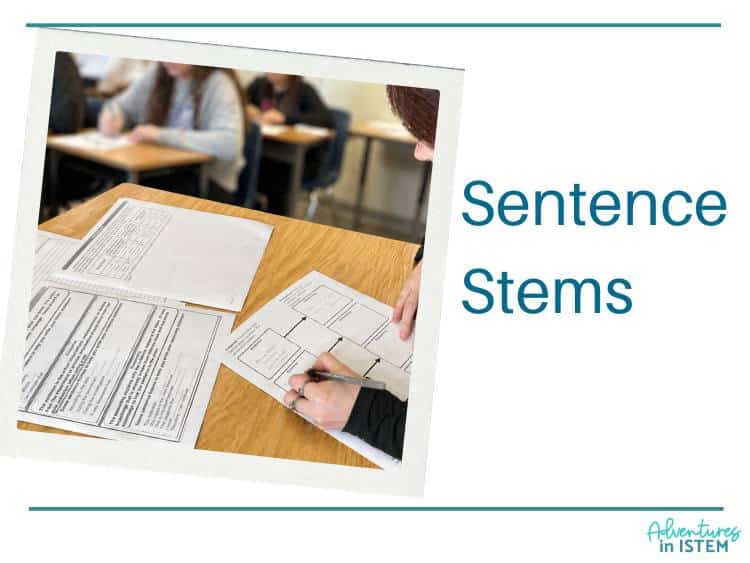
Once students can identify the parts of a strong CER, it is time to start writing their own. And this is where sentence stems come in.
I want to be really clear about something because I hear pushback on sentence stems sometimes: sentence stems are not a crutch. When they are designed well, they teach students the language of scientific explanation while still requiring them to do the actual thinking. The stems give the structure. The student still has to fill it with science. These are especially helpful for your language learners and students that have learning difficulties. It just helps them start their sentences.
Here are the stems I actually use in my classroom:
For the claim:
“___________ causes ___________.”
“________ is the reason for ____________.”
For the evidence:
“The graph / data table / diagram titled _____ states ___________.”
“According to the model / graph / data titled ________, __________.”
For the reasoning:
“This is important because _________.”
“This suggests that ___________.”
“I know ___________.”
Every student starts with these stems. They are glued into their science notebook and they use them every time they write a CER. The stems do not just help students get words on paper, they help them learn the sentence structures of scientific writing so deeply that eventually they do not need to look at the paper anymore.
STAGE 3: WORD BANK — WRITING WITH SCIENTIFIC LANGUAGE
When a student can consistently write a B or higher CER using the sentence stems, it is time to move them to the word bank stage. They do not need the full sentence structure anymore, they just need the language prompts to keep their writing precise and scientific.
My word bank includes words and phrases like:
relationship, causes, affects, according to, demonstrates, furthermore, however, additionally, as a result
This is the core word bank that stays consistent all year. But for each specific CER we also add vocabulary from the current unit, so if we are writing about thermal energy, words like transfer, absorb, and release get added to the list. Students are not just using generic academic language, they are also practicing the specific vocabulary of the science they are learning.
One important thing to know about this stage: not every student in your class will be here at the same time. In my classroom, students are at different levels of the progression depending on how they are doing. The student who moved to the word bank in October might have a classmate who is still on sentence stems in January, and that is completely fine. Each student has their handout glued into their notebook, and when they are ready to move up, the new handout gets glued right on top of the old one. Simple, visible, personal.
STAGE 4: INDEPENDENT — THE GOAL ALL ALONG
Independent does not mean students have nothing. It means the language support is no longer on the paper because it is now inside their head. They have internalized the structure, the vocabulary, and the thinking moves of CER to the point where they can answer a question on their own.
A student is ready for this stage when they can consistently score a B or higher using just the word bank. That is the benchmark I use. It is not a gut feeling, it is evidence. Which feels appropriate, given what we are teaching.
As we get to the last two CER practice problems before the state test I do have all students practice writing their explanations independently with no support. It is important for them to practice in a risk free setting and it also shows them that they are more prepared than they might think they are.
The bigger picture
The scaffolding progression I just described is not a shortcut. It takes time and it takes consistency. Some students will reach independence in December. Others will get there in April or May. What matters is that every student is moving forward, and that when they hit a wall, like that Thursday after Thanksgiving, we know exactly what to do. We go back to the beginning practice. We rebuild the foundation. And we try again.
The skill students build through this progression does not stay in your science classroom. It shows up on the state test. It shows up in their English essays and their history papers. When students learn to make a claim and support it with evidence and explain their reasoning, they are learning how to think and communicate in a way that matters far beyond middle school science.
Ready to try this in your classroom?
If you want a ready-to-use resource that brings all of this together, sentence starters, a graphic organizer, and a rubric that matches the progression, grab my Introduction to CER Template. It has everything you need to start building this scaffold with your students from day one.