
If you have ever been to a professional development session on teaching CER and walked away thinking “this sounds great, but I have no idea where it fits in my already packed curriculum,” you are not alone. That was a common topic of discussion at lunch when CER was first being rolled out during our district PD sessions.
This is the mindshift that changed everything for me: CER is not one more thing to add to my plate. It is a replacement for something I am already doing.
You are already having students do labs. You are already having them analyze data and answer conclusion questions. You are already asking them to demonstrate their understanding at the end of a unit. CER does not add a new activity to your calendar. It changes how students show their thinking inside the activities you already have. That shift in perspective is the difference between teachers who successfully embed CER into their teaching and teachers who try it once, feel overwhelmed, and give up.
In this post, I am going to show you exactly how I embed CER into my 8th-grade science units, including a detailed look at how I use it across an entire chemical reactions unit from the explore phase all the way through the final performance assessment.
Teaching CER starts with looking at what you already have
When I sit down to plan a unit, I am not asking myself, “Where do I add CER?” I am asking, “Where are students already analyzing evidence and answering questions about what they observed?” Those are the exact spots where CER belongs.
For most science teachers, that means two places: labs and activities, or three places if you also do performance assessments at the end of a unit.
In a traditional lab report, students identify a hypothesis, identify variables, do the experiment, and then answer a series of analysis questions at the end. Questions like: What happened when…? What pattern do you notice? What is the relationship between…? What conclusions can you draw? Is the hypothesis supported?
When I convert that lab to CER, those individual questions disappear. Instead, students do the experiment and then answer one guiding question in CER format. They use their observations and their knowledge of the topic to write a claim, support it with evidence from their data, and explain their reasoning using science content. The analysis still happens. The thinking is still there. It is just demonstrated differently, in a format that much more closely mirrors what they will see on the state test.
The same is true for performance assessments. I have taken my end-of-unit assessments and modified them so they end in a CER. Students still do the performance task. They still collect data and make observations. But instead of answering a checklist of wrap-up questions, they write a scientific explanation that shows me whether they actually understand what happened and why.
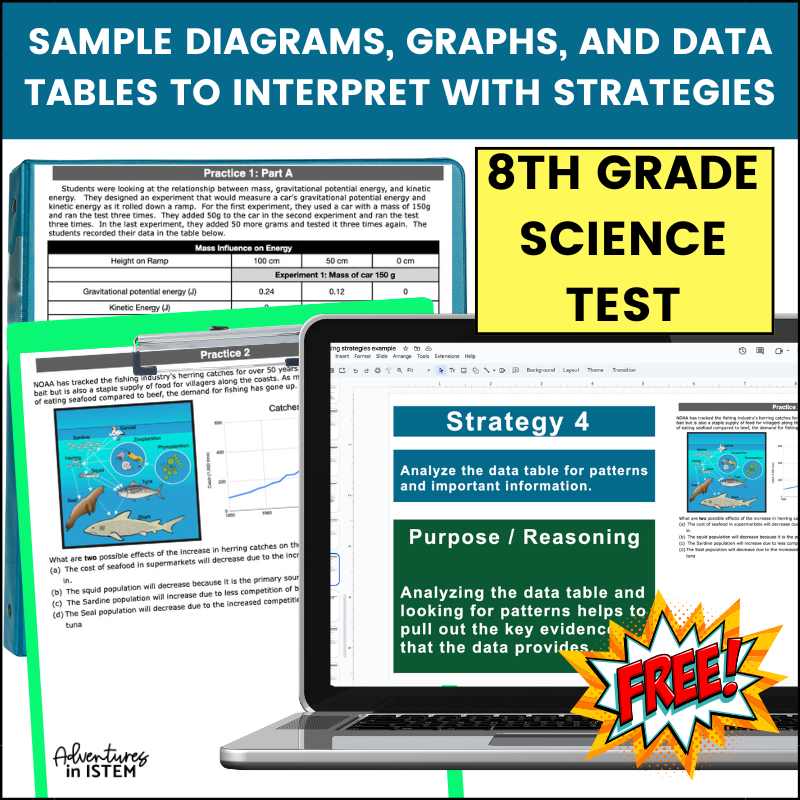
One important thing I want to say about this transition: some students struggled at first because CER is less guided than individual analysis questions. When you remove those step-by-step questions, you are asking students to do their own analysis instead of being walked through it. I solved this by giving students some guiding questions to help them analyze data tables and graphs before they write. Over time, as they wrote more CERs, I noticed they actually got better at data analysis on their own. The guiding questions became less necessary because students had internalized the thinking process. That was one of the most rewarding things I have seen come out of making this switch.
Where CER fits in a unit depends on the question
One of the questions I get most often is: where exactly in a unit should CER go? The answer is that it depends on the question you are asking students to answer.
I use the 5E model in my classroom, and CER can fit in more than one place depending on what the activity requires. If the CER question requires background knowledge about the topic, it belongs later in the unit during the elaborate phase, after students have built that understanding. But if everything students need to answer the question is given to them in the reading, the data, or the images in front of them, then it can work beautifully during the explore phase at the beginning of the unit before formal instruction.
That flexibility is one of the things I love most about CER. It is not locked into one spot on the calendar. It goes where the learning calls for it.
In a typical two- to three-week unit, my students might write anywhere from two to five full CER paragraphs, depending on the topic and how many labs and investigations we do. I aim for at least one CER during the unit and one CER as part of the final assessment. By the time my students sit down for the state test in May, they will have written more than 40 CERs on various science topics. That kind of volume and variety is what builds real mastery.
Not every CER has to be a full paragraph.
Here is the biggest mistake I see teachers make when they start embedding CER into their units: they try to turn every single activity into a full CER paragraph. That is a fast road to burnout for you and for your students.
Full CER paragraphs are valuable, but they take time. Not every activity needs one. What matters is that students are regularly practicing the thinking moves of CER, and sometimes that means a much lighter version of the task.
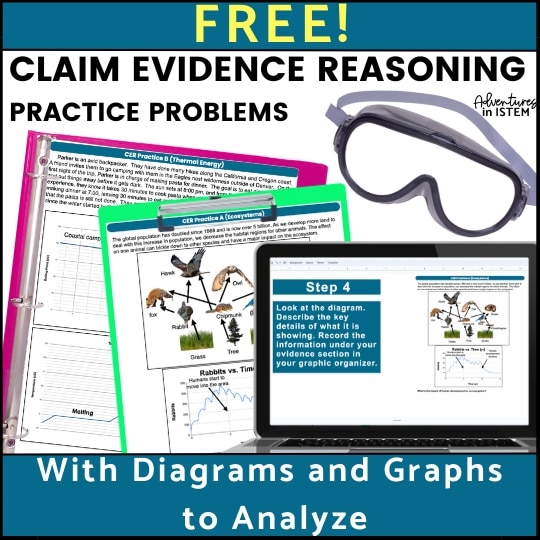
In my classroom, I use abbreviated CER practice all the time. Sometimes students only have to identify the best claim sentence from a set of choices. Sometimes they only have to find the two evidence sentences that support the claim. Sometimes they write one evidence sentence and check off boxes instead of writing their full reasoning. All of these are still practicing the skills of CER. They are just faster and lower stakes.
The goal is to keep students regularly engaged with the format without every practice feeling like a major assignment. Two to three full CER paragraphs in a unit, plus several lighter CER tasks, gives students the volume of practice they need without overwhelming anyone.
What teaching CER looks like in practice: The Chemical Reactions Unit
I want to walk you through a concrete example so you can see how this actually plays out across a real unit. My chemical reactions unit is one of my favorites for showing how CER can be woven throughout without feeling forced or added on.
The unit includes three hands-on experiments and some online, virtual-simulated experiments before the final performance assessment, and CER shows up in each one in a slightly different way.
The first experiment happens during the explore phase, before students have had formal instruction on chemical reactions. I have students mix copper chloride and aluminum and observe what happens. Their job is to tell me whether a chemical reaction has taken place. Since this comes before instruction, everything they need to answer that question has to come from their observations. You can watch this experiment here: https://www.youtube.com/watch?v=_46ZTuM24gU
The next two experiments happen during the elaborate phase, after students have built their understanding of chemical reactions. One uses hydrogen peroxide, copper sulfate, and ammonia. The other uses magnesium sulfate and sodium carbonate. In both cases, students are again determining whether a chemical reaction has taken place, but now they can draw on their science knowledge to explain their reasoning more deeply.
We also use the Explore Learning Gizmo on chemical change, where students mix substances in an online simulation and do CER practice for each combination. But here is where the lighter CER format comes in. Instead of writing full paragraphs, students choose the correct claim sentence from two options: “Mixing ___ and ___ results in a chemical change” or “Mixing ___ and ___ does not result in a chemical change.” Then they write one evidence sentence to support the claim they chose. Finally, they check off boxes for the evidence of a chemical reaction they observed instead of writing out their full reasoning. It is still practicing every part of CER. It just takes a fraction of the time.
Then at the end of the unit comes the performance assessment. Students mix sodium bicarbonate, calcium chloride, and phenol red, observe the results, and write a full CER paragraph to explain whether a chemical reaction has taken place. You can see this experiment here: https://www.youtube.com/watch?v=DA3v6QRpuuc
By the time students reach that final CER, they have already practiced the thinking multiple times across the unit in different formats and at different levels of depth. The performance assessment does not feel like a surprise. It feels like the next logical step.
A note on pacing and not starting from scratch
If you are reading this and feeling like converting your labs and assessments to CER is going to take forever, I want to offer some reassurance. You do not have to change everything at once.
Start with one unit. Look at the labs you already have and pick one where the guiding question is clear and the data is something students can actually use as evidence. Convert just that one lab conclusion to a CER. See how it goes. Then do one more.
Over time you will develop an eye for which activities lend themselves naturally to CER and which ones do not. Not everything needs to become a CER, and forcing it into every single activity is not the goal. The goal is regular, meaningful practice embedded in the science content your students are already learning.
The bigger picture
When I tell teachers that CER is not one more thing to add to their plate, I mean it. The labs you love are still there. The performance assessments you have spent years refining are still there. The investigations, the hands-on activities, and the simulations are all still there.
What changes is the last step. Instead of a list of guided questions at the end, there is one meaningful question that asks students to put their thinking together in a way that actually looks like science. That is not more work. That is better work.
And the payoff is real. By May, my students have written over 40 CERs. They know how to look at data and make a claim. They know how to use specific evidence. They know how to explain their reasoning using science content. Those are skills that show up on the state test, in their English and history classes, and long after they leave my classroom.
Ready to try this in your classroom?
If you want to see exactly how CER works embedded into a full unit, my Chemical Reactions 5E Lesson gives you the complete unit with hands-on labs, videos, and CER embedded throughout, so your students are practicing scientific explanation at every stage of the learning.