
It is Thursday afternoon. You have a stack of CER paragraphs to grade, and all you can think of is, “Will I be able to get through all of these today without having to stay late or continue working over the weekend?” You open the first one, read it carefully using your rubric, write a comment about the missing numbers in the evidence, another comment about the reasoning not connecting back to the claim, and move on to the next one. Twenty minutes later, you have graded five papers and written essentially the same comments on all five of them. Your thinking, there goes another late night and weekend.
Sound familiar?
Before I figured out my current system, grading 125 CER paragraphs took me almost 3 hours. Not because the rubric was complicated, but because I was writing the same corrections over and over again. Missing numbers in the evidence. Reasoning that just repeats the claim instead of explaining the science. Evidence with no source cited. Same mistakes, same comments, paper after paper after paper. Even if I gave the students the rubric ahead of time, they still made the same mistakes. And let’s be honest, do they even read the rubric ahead of time?
However, after making a simple change, I can now grade those same 125 CERs in about an hour and a half. Plus, my students are turning in better paragraphs before I even look at them.
Here is how I do it.
Teaching CER: Start with a rubric that leaves no surprises
The foundation of efficient CER grading is a rubric that your students actually understand before they write. Not a rubric you hand back with the grade on it. A rubric they study, discuss, and use to self-evaluate while they are writing.
I always had a rubric and gave it to them, but now I make sure we actually go over it. We talk about the difference between a 3 and a 4. They then create a small check-off list that includes the most important parts that a 4 or 5 paragraph needs to have for each part. This way, I know they actually understand what is expected.
I use standards-based grading and follow the Marzano method. So, I use a five-point rubric that grades claim, evidence, reasoning, and mechanics separately. With standards-based grading, a 5 or an A means they are exceeding the standards. So if the standard is to write a claim that answers the question and is supported by evidence, then a 5 would include a counterclaim. Below is the rubric I use.
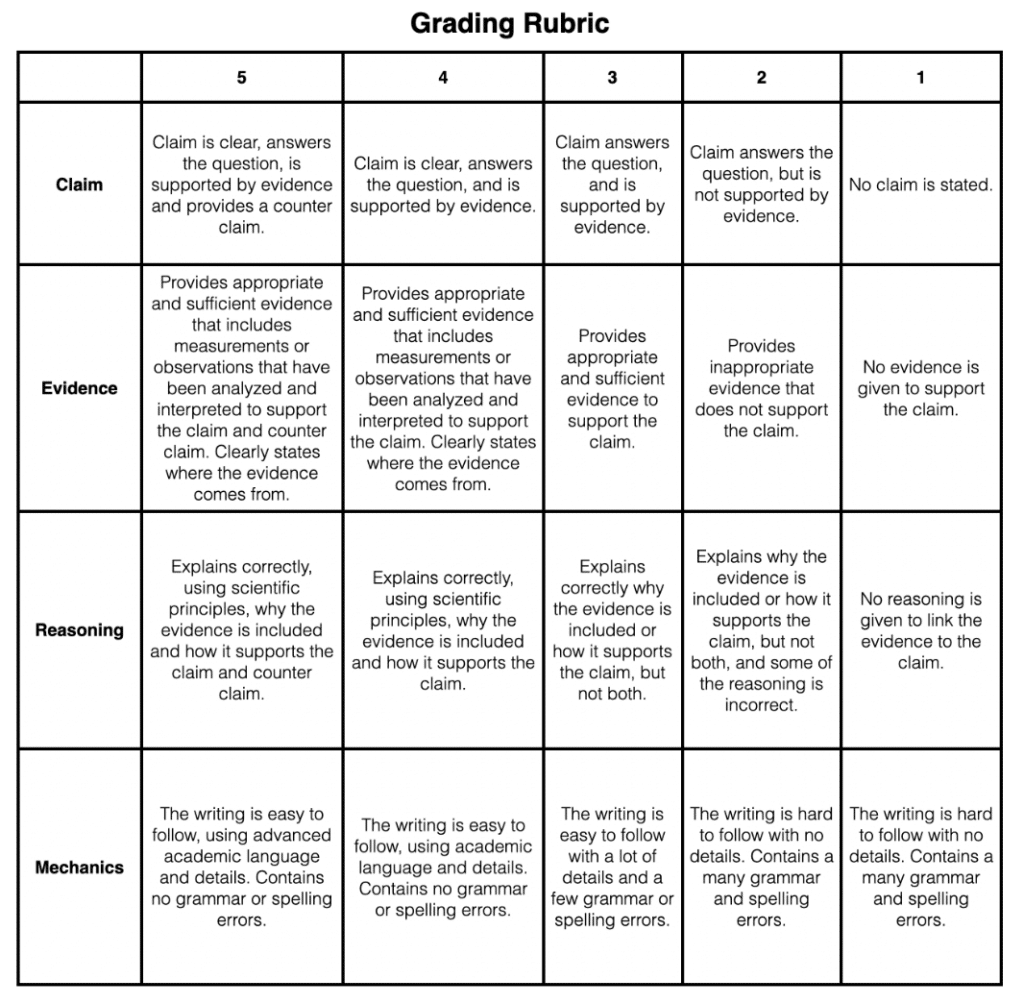
Not all CER paragraphs can incorporate a counterclaim, but it is important to help students understand how to do so. That is why I introduced the counterclaim right at the beginning of the year during our first forensic CER investigation. We talk about how the evidence might suggest one conclusion, while another explanation is also possible. For example, in my Sir Edward Berkshire the Third CSI investigation, the students might say that Sir Edward Berkshire the Third was murdered and did not die of natural causes. The claim is that he was murdered; the counterclaim is that he did not die of natural causes. Another example of a claim-counterclaim for gas laws could be about the relationship between pressure and volume of a gas being inverse and not direct. The claim is that the relationship is inverse, while the counterclaim is that it is not direct.
Teaching CER: The workflow that cut my grading time in half
Here is the part of my process that made the biggest difference: my students do not submit a final CER paragraph until they have already received feedback and revised their writing. By the time I sit down to grade, the most common mistakes have already been caught and corrected.
This is how the workflow goes.
Students do all of their brainstorming, graphic organizers, and text annotation on paper. But when it comes time to write the actual CER paragraph, they do it on the computer. This is an intentional choice. I know there is a lot of conversation right now about reducing screen time and having students write by hand more often, and I agree that students need handwriting practice. But the CER paragraph is the piece where I want them to have access to AI feedback tools, and that requires being on a device. The skills they are building by learning to work with AI feedback are skills they will need long after they leave my classroom.
Once students have written their paragraph, they submit it to a MagicSchool room I have set up specifically for CER feedback. I set it up so students cannot just write one sentence and then submit it for guidance on how to write their paragraph. MagicSchool checks whether they have written at least 3 sentences that cover a claim, evidence, and reasoning. If they have not, it tells them to go back and finish writing first. This single step alone has significantly reduced the number of incomplete submissions I receive.
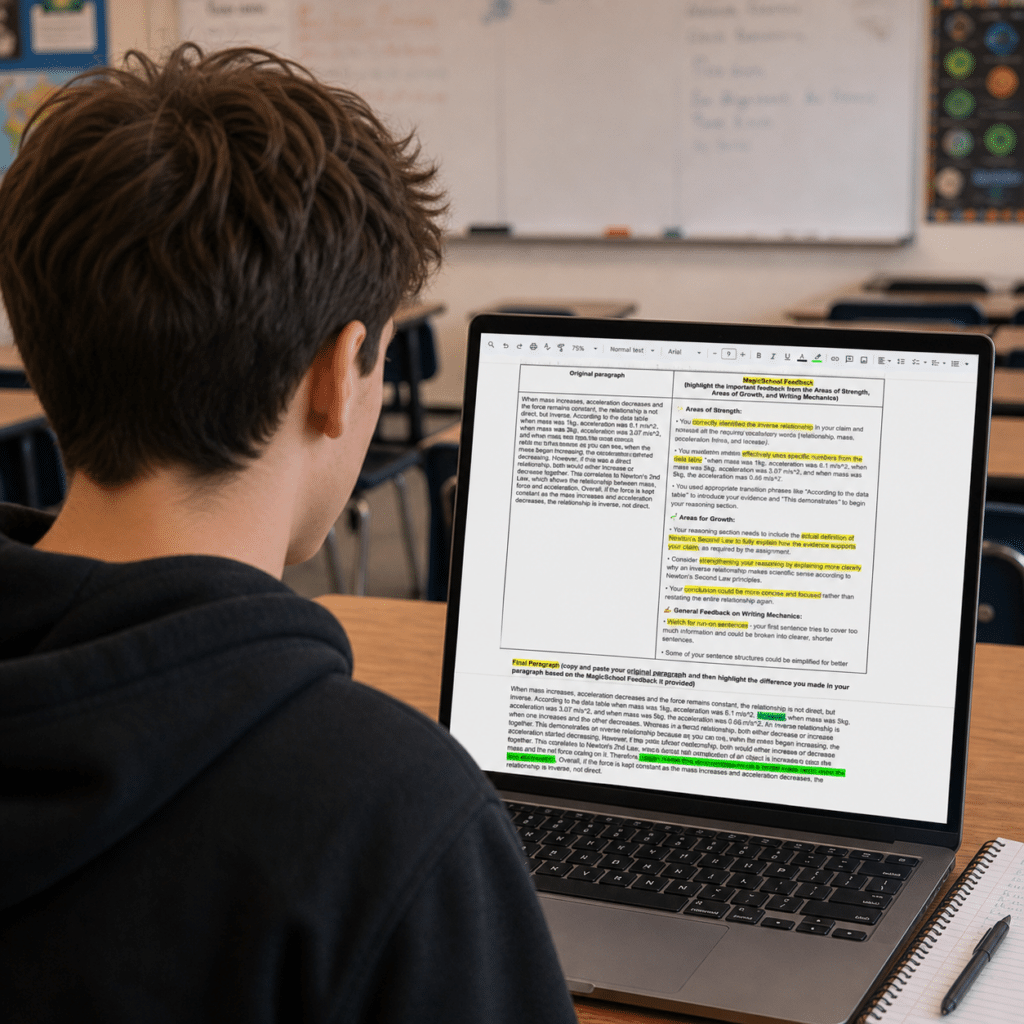
When students receive their feedback from MagicSchool, they need to copy and paste their initial feedback into their document. MagicSchool will tell them what their strengths are, what their areas for growth are, and provide information about their mechanics. They then need to highlight the key pieces of feedback. This makes sure that not only do they read the feedback, but that they understand it, or if they do not, know what questions they need to ask MagicSchool.
I also teach students that MagicSchool is not always right. I tell them to read the feedback carefully, decide whether they agree with it, and if they do not, to ask MagicSchool how it came to that conclusion. Some students take the feedback at face value without questioning it, and then, when my grade differs from what MagicSchool suggested, they get frustrated. This is actually a great teaching moment about AI literacy. The tool is helpful, but it is not infallible, and learning to evaluate AI feedback critically is one of the most important skills I can teach right now. They need to learn how to have conversations with AI and question where it gets its information, or, in this case, why it is giving certain feedback. I have also set into place that if students ask for ideas, MagicSchool will give them at least five different options. That way, students can pull different ideas from each one to make their own.
When students write their final paragraph, based on MagicSchool’s feedback and interaction, they need to highlight how it differs from the original. What sentences, or parts of sentences, did they revise? Did they add missing numbers? Did they add transition phrases? The final, revised paragraph goes below the original so that the students and I can see the improvement in their writing.
That highlighting step is important for two reasons. For students, it makes their own growth visible. They can see exactly what they improved and how their thinking changed. For me, it speeds up grading because I can go directly to the highlighted sections and see what changed without re-reading the entire paragraph.
Teaching CER: How I actually grade the stack of CER paragraphs
Because students write and submit through Google Classroom, I can move quickly from one student to the next, enter their rubric scores, and add a brief note if needed. Once the whole class is graded, I upload directly from Google Classroom into our gradebook. It is clean and fast.
My comments at this stage are minimal. I might note that a claim should not include an explanation, just a direct answer to the question. I might ask where the data came from if the source is missing. I might point out that numbers are still missing from the evidence even after revision. Short, specific, actionable.
I do not write paragraph-length feedback on every paper. The MagicSchool step already handled the heavy lifting. My job at grading time is to apply the rubric consistently and flag anything that was not caught during the revision process.
One thing that keeps students engaged with the feedback they do receive: I allow them to fix their grade. If a student receives a 3 and wants to revise again based on my comments, they can do that and resubmit. This means students actually read what I write instead of just looking at the number. It also means the feedback loop does not end when I hand back the grade.
A word about AI and authentic student writing
I want to address something directly because it comes up whenever I talk about using AI tools with students. How do you know the student actually wrote it?
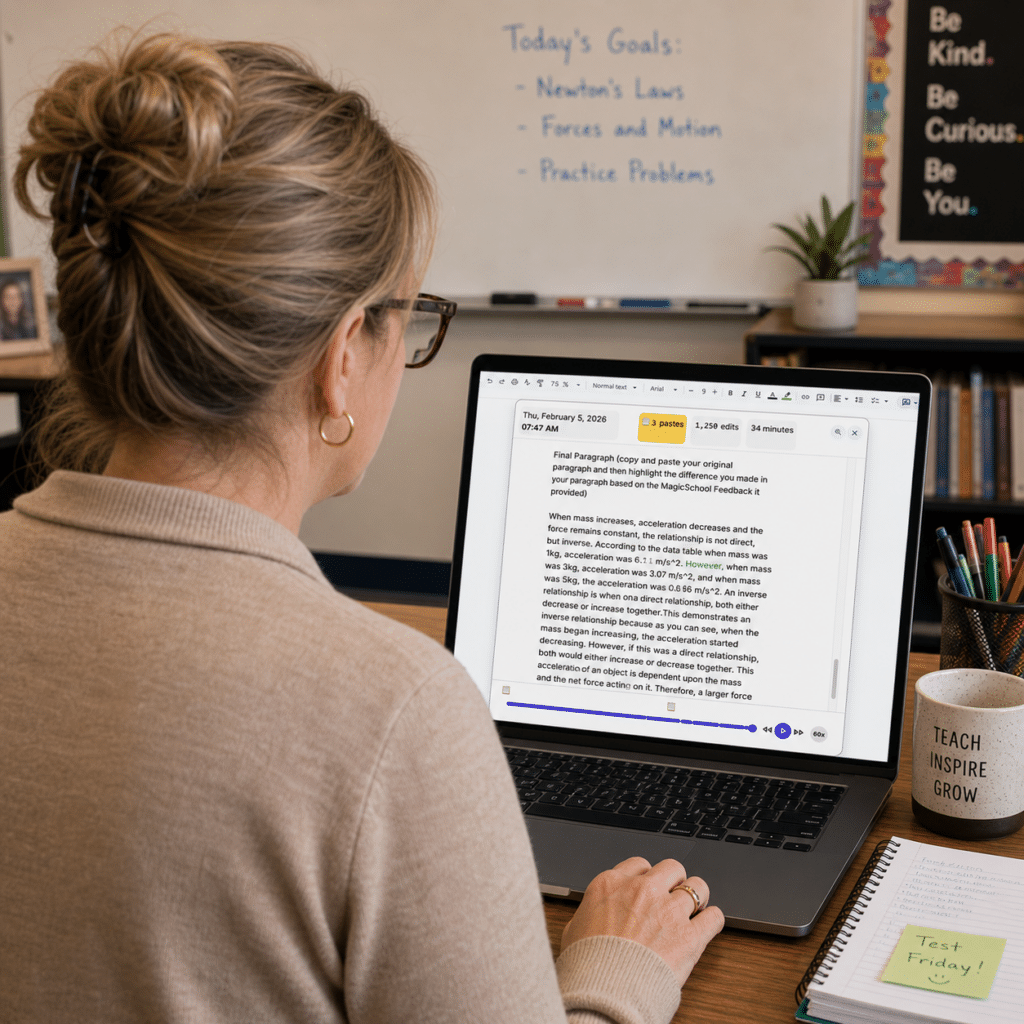
I use a tool called Brisk, specifically the Inspect Writing feature, which is currently included in the free educator plan. Brisk can show me when a significant paste event happened in a document, how long it took a student to write their paragraph, and where the student’s own typing ends and something else begins. I show my students this tool before we ever use it, so they know exactly how it works and what I can see. Transparency matters here.
My expectation is clear, and I say it to my students directly: AI should help improve our writing and our thinking, not do the writing and thinking for us. Out of over 30 CERs given to 125 students this year, so roughly 3,750 graded CERs, I have caught two students where a polished paragraph appeared that was completely different from their original draft and did not sound like them at all. Two. The combination of requiring students to keep their original paragraph, highlight their changes, and knowing Brisk exists has made academic honesty a much smaller problem than I expected.
The bigger picture
The reason this system works is not just because of the tools. It is because every step has a clear purpose. The rubric sets expectations before students write. MagicSchool gives feedback before I grade. The original and revised paragraphs show growth. The highlighting makes revision visible. Brisk protects the integrity of the work. And allowing grade fixes keeps students invested in improving.
When all of those pieces work together, grading becomes less about correcting and more about confirming. I am not discovering mistakes for the first time when I sit down with the stack. I am looking at work that has already been thought about, revised, and improved. That is a very different experience from the Thursday afternoon grading marathon I used to dread.
Teaching CER: Ready to build this system in your classroom?
If you want to implement the grading workflow I described in this post, CER Academy gives you everything you need in one place. You will get the Introduction to CER Template with the rubric, sentence starters, and graphic organizers so your students know exactly what is expected from day one. You will also get a deep dive on how to set up MagicSchool for CER feedback the right way, how to build this system across your entire year, and how to use AI tools in ways that actually improve student thinking rather than replace it. All of that comes with live coaching calls so you can ask questions specific to your classroom.