
Most periodic table units follow the same script. The focus is on having students learn how to read a period and a row, and then move on to the three main categories. Students do color-coding activities, watch videos, and do a variety of interactive notebook activities, then end with a project like the most wanted element. While it works, it doesn’t engage the students and help them learn the information as well as using the 5E model does.
I love how the 5E model keeps students thinking and engaged the whole way through. Plus, throw a little student choice in, and the students really take ownership of their learning.
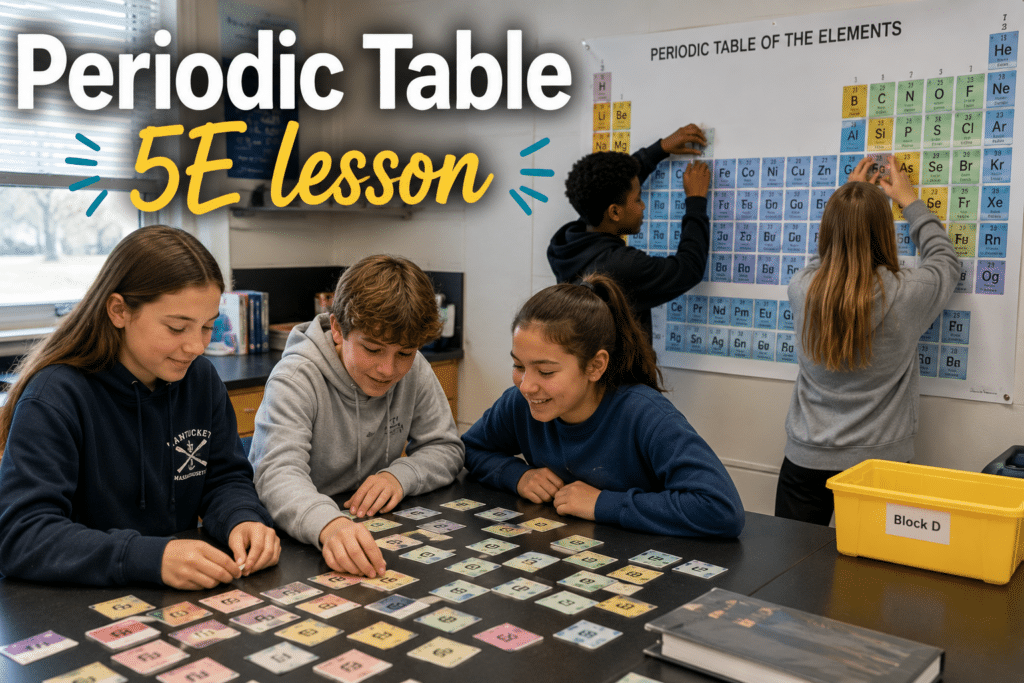
The periodic table isn’t about memorizing the elements and their location. It’s about understanding how to read it and unlock the secret of an element’s properties. Once students see the patterns; location of the metals, nonmetals, and metalloids; the families that run down the columns; the way an element’s spot tells you how it behaves, the whole table starts to make sense instead of looking like a wall of symbols to copy down.
How to teach the Periodic Table using the 5E model
1. Engage: a quick inquiry investigation (1 day)
Before any notes, students complete an inquiry investigation in which they categorize shapes that model the elements. From sorting those shapes, they start to figure out how scientists use the table to predict the properties of an element they’ve never seen. They notice the pattern first. Hook first, vocabulary later.
2. Explore: science stations (3 days)
Next, they rotate through three periodic table science stations:
- An online station to learn the basics of the table on their own.
- A group-collaboration station where students interpret diagrams to discover the patterns of the periodic table.
- A teacher-led station where you guide them through researching elements and discovering their real-world uses.
The rotation keeps middle schoolers moving, and each station works the same idea from a different angle. Three different ways to engage with the periodic table.
3. Explain: flipped lesson or in-class readings
This is the direct-instruction piece, and you can run it whichever way fits your classroom.
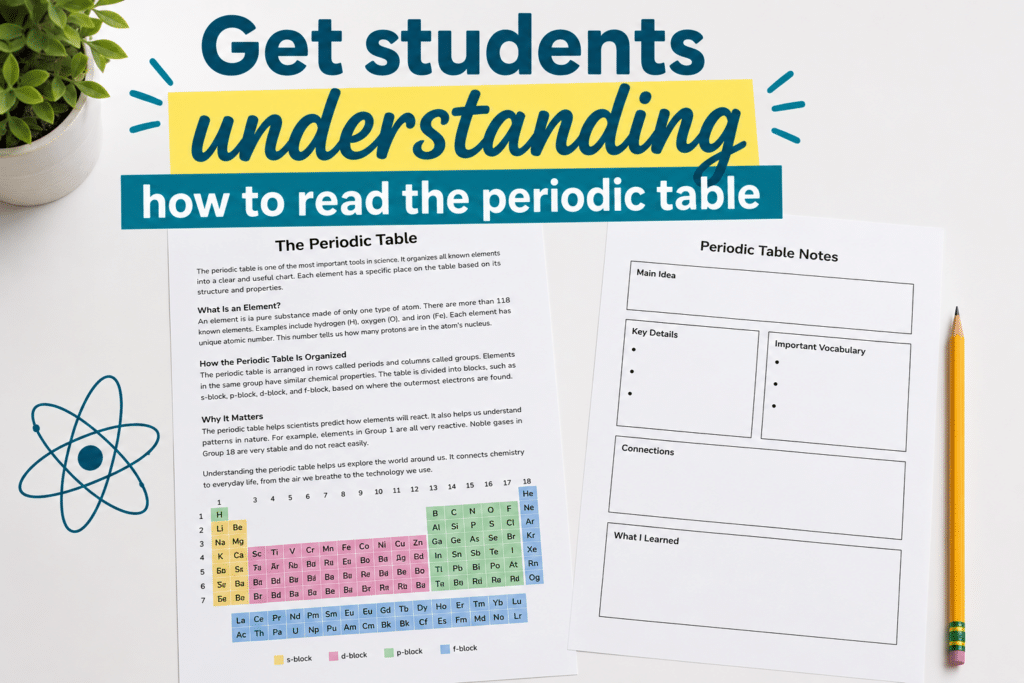
Flipped (done at home): a video with a note-taking template, a short formative quiz, a review activity (a one-page reading with its own note-taking template and comprehension worksheet), and an extension activity where students investigate elements and how they’re used.
In class (2 days): the same content as three-level science readings: the periodic table, the categories of the periodic table, and the families of the periodic table, with a note-taking template, a comprehension worksheet, and four extension task cards.
This is also the perfect spot to level those readings for every reader in your room. I walk through exactly how I do that in my post on differentiating science reading with AI [internal link — Post 09, add once live].
Or you can also do it as science stations where they have a video, a reading, and a podcast (I use Brisk to change my videos into podcasts). There are different learning modes to take notes from and get the basic foundation.
4. Elaborate: the Menu Choice project (5 days)
Elaborate is where students apply and stretch what they know. This phase starts with an extension or review, depending on what the students need based on a quick formative assessment after the explain phase. Then it moves into a digital notebook review covering the periodic table, its categories, and its families. Finally, and this is the part students remember most: the Periodic Table Menu Choice.
The menu gives students five projects to pick from:
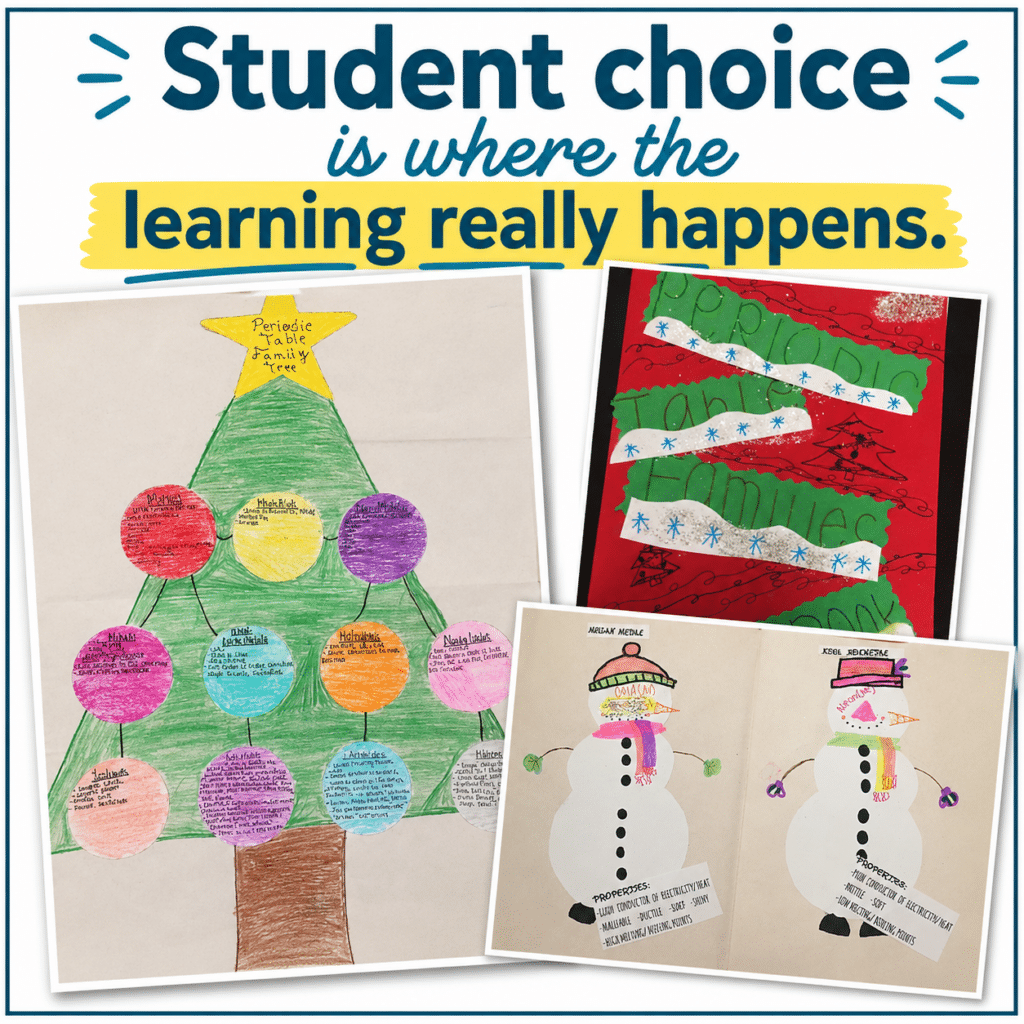
- Periodic Table Family Tree — build a family tree of the main families and categories, with the properties of each and one example element per family.
- Most Wanted Element — students get an element, fill out its profile (properties, uses, discovery), and design a “most wanted” poster for it.
- Periodic Table Family Scrapbook — a scrapbook of the families, giving each one a “human name” based on its group (think “Megan Metal”) with a picture and its characteristics.
- Advertisement — students decide which type of element (metal, nonmetal, metalloid) is most useful and make an ad or commercial making the case, with examples.
- Building on Contaminated Land — students research Superfund sites, take on a point of view (builder, factory worker, landowner, neighbor), and write a persuasion essay for or against building there.
The menu choice is my favorite part of the whole unit. I used to assign one project to everyone in the class, building the most wanted element, or everyone doing the scrapbook. When I switched to letting students choose, the end products got more robust, more students actually finished them, and they had fun doing the project they picked. Choice puts them in charge of how they go deeper.
The differentiation is built right in. You can let students choose their own project, pick one for the whole class, or assign by readiness. The Family Tree and Scrapbook work as the more accessible review, the Most Wanted Element and Advertisement sit in the middle, and Building on Contaminated Land is the high-level option that asks students to research and argue a real position. Most choices come with directions and an example to guide students. I leave the Advertisement one example-free on purpose; when I give an example there, the creativity drains right out, so instead I have students look up real ads in magazines, newspapers, and online.
5. Evaluate: the quiz (2 days)
Close the unit with a periodic table quiz and interactive notebook review pages. The quiz includes multiple choice plus two leveled short-answer versions, so every student gets a fair shot at showing what they actually learned, not just how fast they read.
You could also use the menu choice as an assessment piece. The great thing about having so many activities to choose from is that you can move things around.
Grab it ready to teach.
Every piece above: the inquiry investigation, the stations, the leveled readings, the flipped lesson, the menu-choice project, the digital notebook, and the quiz is already built into my Periodic Table 5E lesson. If you’d rather not assemble a two-to-three-week unit from scratch, I’ve already done it for you.
How do you teach the periodic table in your room? Do you lean on a project, stations, or something else? I’d love to hear what finally makes it click for your students. And pin this post so it’s ready when the unit comes around.