If you have ever searched for resources on teaching CER to English Language Learners or students with IEPs, you have probably noticed something: almost everything out there is written for a general classroom. The assumption is that your students can read the prompt, understand the vocabulary, organize their thinking, and get words on paper without too much trouble.
But that is not the classroom a lot of us are actually teaching in.
I teach 8th-grade science at a school where 40% of students are English Language Learners, another 37% are Redesignated Fluent English Proficient, meaning they have moved out of ELL programs, but many still need language support, and 94% of students are considered socioeconomically disadvantaged. On top of that, about 17% of my students qualify for special services due to a learning disability. In a typical class, whether it is advanced or regular, nearly half my students need some form of language support to access the curriculum.
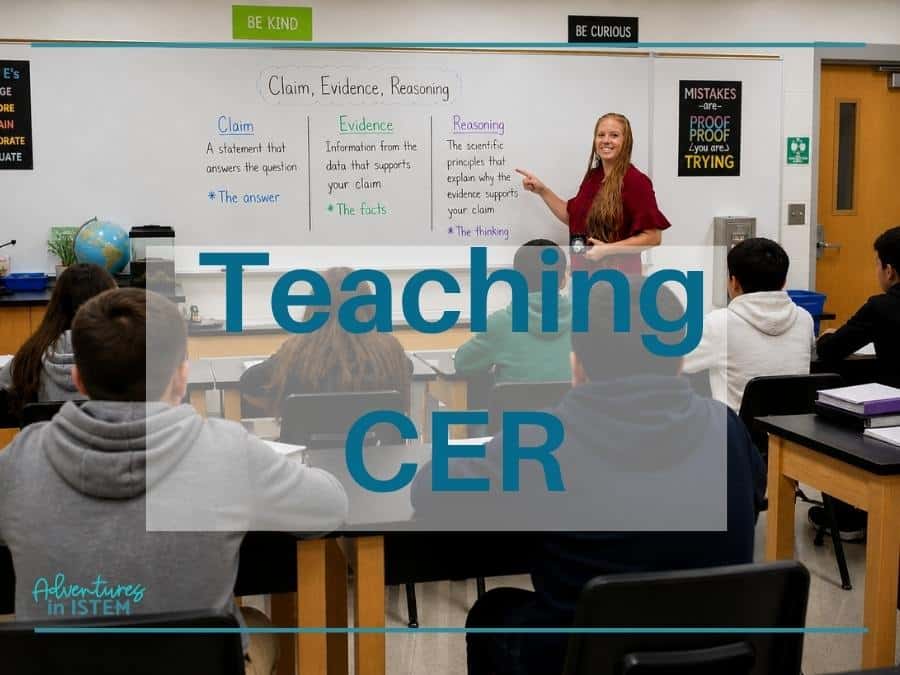
I have been teaching this population for over 25 years. And I can tell you with complete confidence that CER is not too hard for these students. What makes it seem difficult is being handed a blank piece of paper and told to write a scientific explanation with no support, no language scaffolds, and no on-ramp into the task.
The strategies I am going to share in this post are not workarounds or watered-down versions of CER. They are just good teaching. And here is something I want you to hold onto as you read: the support you give your ELL students and your students with IEPs can be used for all of your students. When you build these strategies into your classroom, you are not making exceptions. You are just doing good teaching.
Teaching CER: The most important thing to understand first
Before we get into specific strategies, I want to name something that I think is at the root of why so many teachers struggle with this.
The biggest mistake I see teachers make with ELL students and students with IEPs when it comes to CER is one of two things: either not providing language support at all, or pulling the support away too early.
These are not students who need a simpler version of CER. They need the same progression as every other student: sentence choice, sentence stems, word bank, and independent writing, but they may need more time at each stage, and some of them will need certain supports for longer periods than their peers. Some of my language learners use the sentence stems all year. I do not pull that support just because the calendar says it has been long enough. I pull it when the student shows me they are ready, and for some students, that moment comes later than others. That is not a failure. That is responsive teaching.
The rubric does not change for these students. Most students with IEPs in a general science classroom have accommodations, not modifications. That means the expectation is the same, but the path to getting there looks different. Extra time. Printed notes. Graphic organizers. Language support that stays in place longer. These are not lower standards. They are different doors into the same room.
The scaffolding progression still works, with a few adjustments
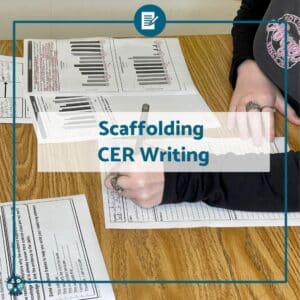
If you read my post on scaffolding CER, you already know the four-stage progression I use: sentence choice, sentence stems, word bank, and independent writing. The good news is that this progression works for ELL students and students with IEPs too. The path stays the same. What changes is the pace and how long you spend at each stage.
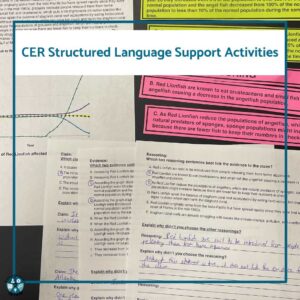
For classes with a high percentage of ELL students, I spend more time in the sentence choice stage. In this stage, students are not writing yet. They read pre-written sentences and decide which one is the best claim, which two work as evidence, and which one is the reasoning. For language learners, this does more than build CER understanding. It builds academic vocabulary, exposes them to the structure of scientific writing, and gives them clear models of what strong scientific language looks and sounds like before they are asked to write on their own.
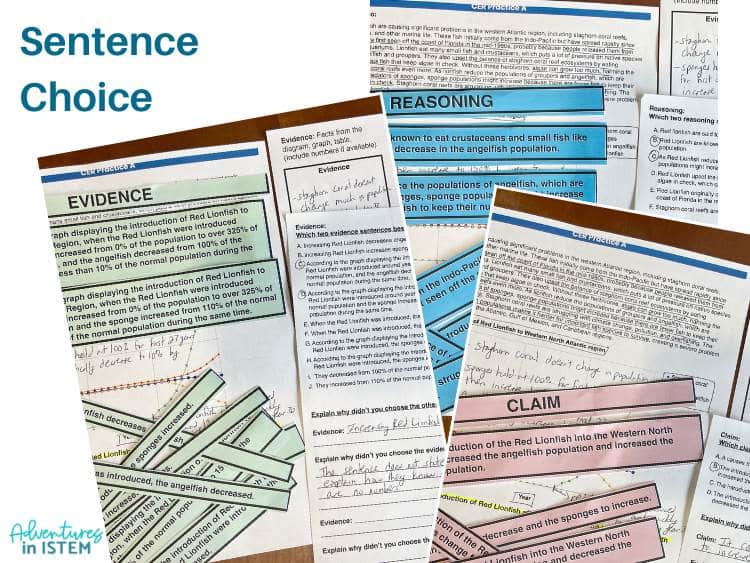
I also go back and forth between sentence choice practice and full writing instead of moving through the stages in a straight line. Some weeks, we focus on a full CER using sentence stems. Other weeks, we return to sentence choice to reinforce vocabulary and structure. This flexibility keeps the progression from feeling rigid and gives students more time with the models they need. They get a chance to practice writing, then revisit what a strong claim, evidence, and reasoning look like.
Sometimes I find it useful to use the same topic and modify it slightly so that I can use it as both a sentence choice and a full written CER. For example, during my analog and digital signals unit, students first completed a sentence choice activity where they read about the topic and analyzed diagrams. Then we revisited the same concept with a new situation and different diagrams, but this time students wrote their own CER. Giving them practice with first what this would look like in a sentence choice format before they had to write their own helped them with the vocabulary and writing process.
Specific strategies for English Language Learners
Beyond the scaffolding progression, here are the specific strategies I use with my ELL students.
Sentence stems are non-negotiable for language learners, and some will use them all year. That is completely fine. The stems give students the structure of scientific language so they can focus their mental energy on the science content instead of the sentence construction. For a student who is still building English fluency, having to figure out how to start a sentence at the same time as trying to explain gas laws is too much. The stem removes one barrier so the thinking can come through.
Google Translate is a tool I allow ELL students to use, especially those who are still developing English proficiency. I want to know what students understand about science. If a student needs to draft their thinking in their home language first and then translate it, that is fine with me. The goal is scientific understanding, not English fluency in isolation.
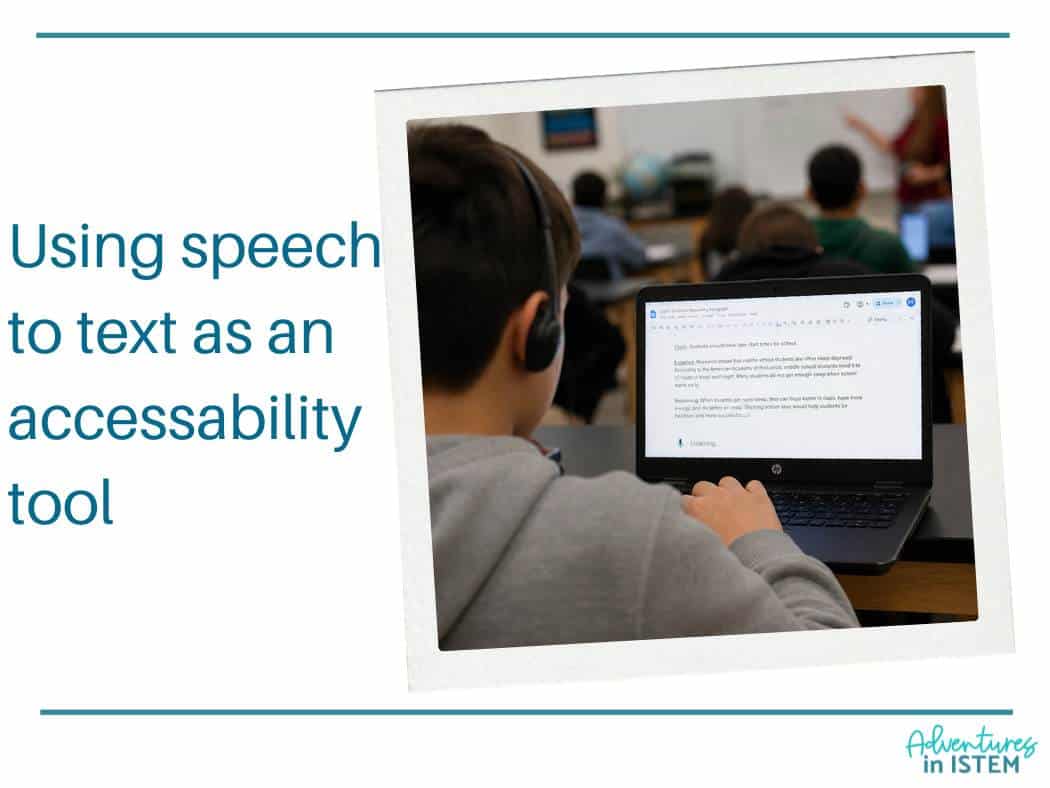
Google speech-to-text has been especially powerful for some of my students. I had one student, whom I will call Jennifer, who could explain her scientific thinking beautifully when I asked her verbally. She had the reasoning in her head. She just had tremendous difficulty getting it from her head onto the paper. The combination of the sentence stems on the page and Google speech-to-text allowed her to speak her answer first, visually see it on the document, and then go in and modify it. That process made the invisible visible for her. What was locked in her head finally had a way out.
Strategic language support before the writing matters too. Going over key vocabulary before students write a CER, not just defining terms but using them in context, connecting them to visuals, and having students practice using them in a sentence, makes the reasoning section dramatically stronger. When the vocabulary is solid before writing begins, students have the language they need to explain the science.
Specific strategies for students with IEPs
For students with IEPs in my general science classroom, the most common accommodations I work with for CER are extra time, printed notes, graphic organizers, and extended access to language support like sentence stems.
The sentence stems are especially important for students whose IEPs include language-based learning challenges. Just like with ELL students, having the stem available removes the barrier of sentence construction so students can focus on the thinking. For some students, this accommodation stays in place all year, and that is appropriate.
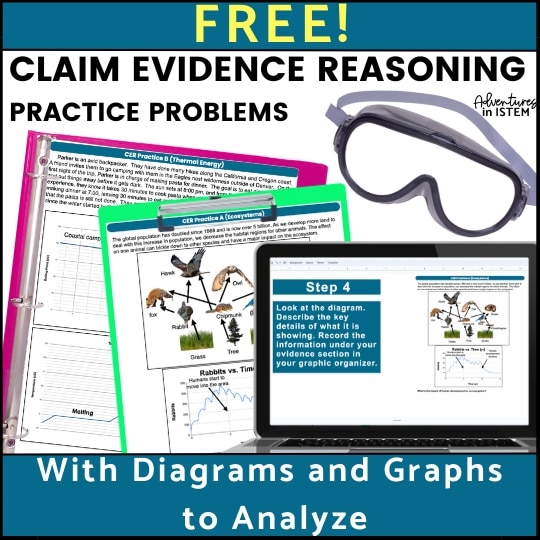
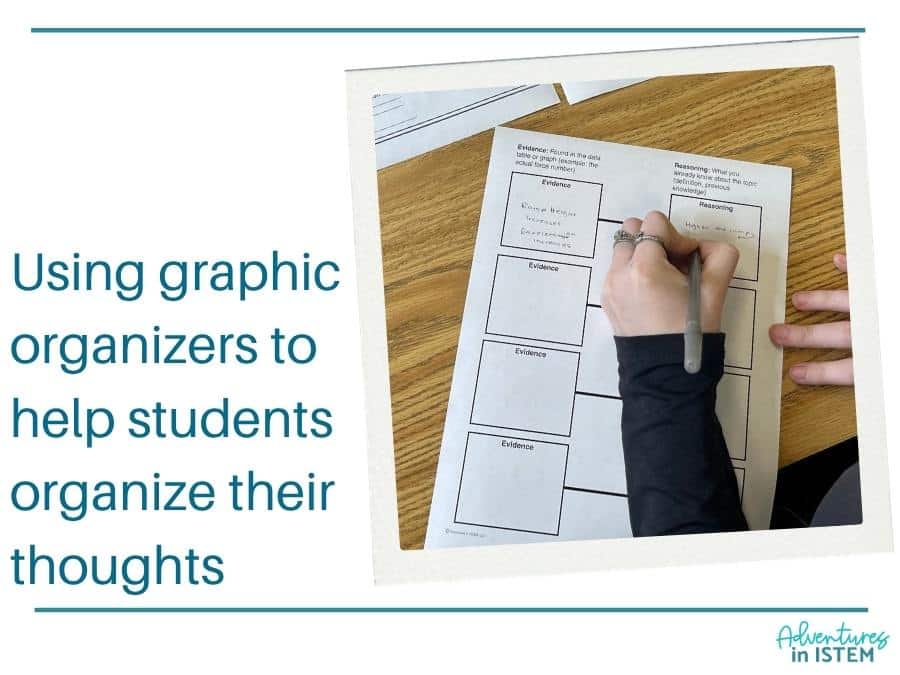
Graphic organizers are something I use with all of my students during the brainstorming phase. They do their text annotation, graphic organizer work, and evidence collection on paper before ever writing the paragraph. For students with IEPs, this structured pre-writing step is especially critical. It breaks the overwhelming task of writing a CER paragraph into smaller, manageable pieces. The organizer becomes a plan. The paragraph becomes the execution of the plan. That separation reduces the cognitive load significantly.
Extra time matters most during the reasoning section. Reasoning is the most complex component of CER because it requires students to explain their thinking using science content, not just report what they observed. For students who process more slowly or who have writing as a significant area of challenge, giving them adequate time for that one section can make the difference between a 2 and a 4 on the rubric.
MagicSchool works the same way for these students as it does for the rest of the class. The feedback MagicSchool gives is based on what the student actually wrote, so it naturally meets students where they are. A student who writes a simpler paragraph will get feedback that addresses what is in that paragraph. The tool adapts to the writing, which means it is already differentiated by design.
Practicing without support before the state test
As we get close to the state test, I do something that might feel counterintuitive at first. I remove the language support for one or two practice CERs and ask all students, including my ELL students and students with IEPs, to write independently.
I frame it very carefully. I tell them this is not a test. It is a practice run so they can see how ready they actually are before they have to do it on the state test. And what usually happens surprises them. Students who have been convinced they cannot write a CER without their sentence stems discover that the language has become more internalized than they realized. They can do more than they thought.
That moment of surprise is one of my favorite moments of the year. It does not happen for every student. Some still struggle significantly without support, and that is information too. But for many of my ELL students and students with IEPs, that practice run is the first time they see their own growth clearly. The support has been doing its job all along, and now they get to see the evidence of that.
What this really comes down to
After 25 years of teaching a highly diverse population, here is what I know to be true: ELL students and students with IEPs are not students who need a simpler version of CER. They are students who need more intentional support to access the same rigorous task.
The sentence stems, the speech-to-text, the graphic organizers, the extended time, and the sentence choice practice do not lower the bar. They raise the floor so more students can reach the bar. And when you build these supports into your classroom for your students who need them most, you will find that all of your students benefit. Because these are not special education strategies or ELL strategies. They are good teaching strategies.
If you are waiting until your students can handle CER without support before you teach it, you will be waiting a long time. Start where they are. Give them the support they need. Move them forward at the pace they can handle. That is the job.
Teaching CER: Ready to build this system in your classroom?
If you want to implement the grading workflow I described in this post, CER Academy gives you everything you need in one place. You will get the Introduction to CER Template with the rubric, sentence starters, and graphic organizers so your students know exactly what is expected from day one. You will also get a deep dive on how to set up MagicSchool for CER feedback the right way, how to build this system across your entire year, and how to use AI tools in ways that actually improve student thinking rather than replace it. All of that comes with live coaching calls so you can ask questions specific to your classroom.