
I’m not the type of teacher who likes to start the first days of school by going over the syllabus and talking about rules. I teach mostly 8th graders, and by now, they know the basic rules. Classroom and school rules really haven’t changed much since they started kindergarten. Now, whether they follow them or not is a different story.
Instead, I like to get them up, moving, and talking. Let’s face it, they haven’t been in a classroom for over 2 months. They aren’t used to just sitting there for hours, class after class, listening to a teacher talk, which is what it is like in many classes. They need movement, they need to be talking and discussing, and they need time to slowly get back into a school routine. That’s why I like starting my year with team-building activities and doing science.
What makes a good team-building science activity
A good first-week activity is low-prep for you, low-stakes for students, gets everyone participating, is engaging, and sneaks in a real science skill without the students knowing. Luckily, there are many activities out there that do just that.
Team-building activities for the first week:
Here are eight activities that are fun, engaging, and perfect to do during the first week of school.
1. Save Fred
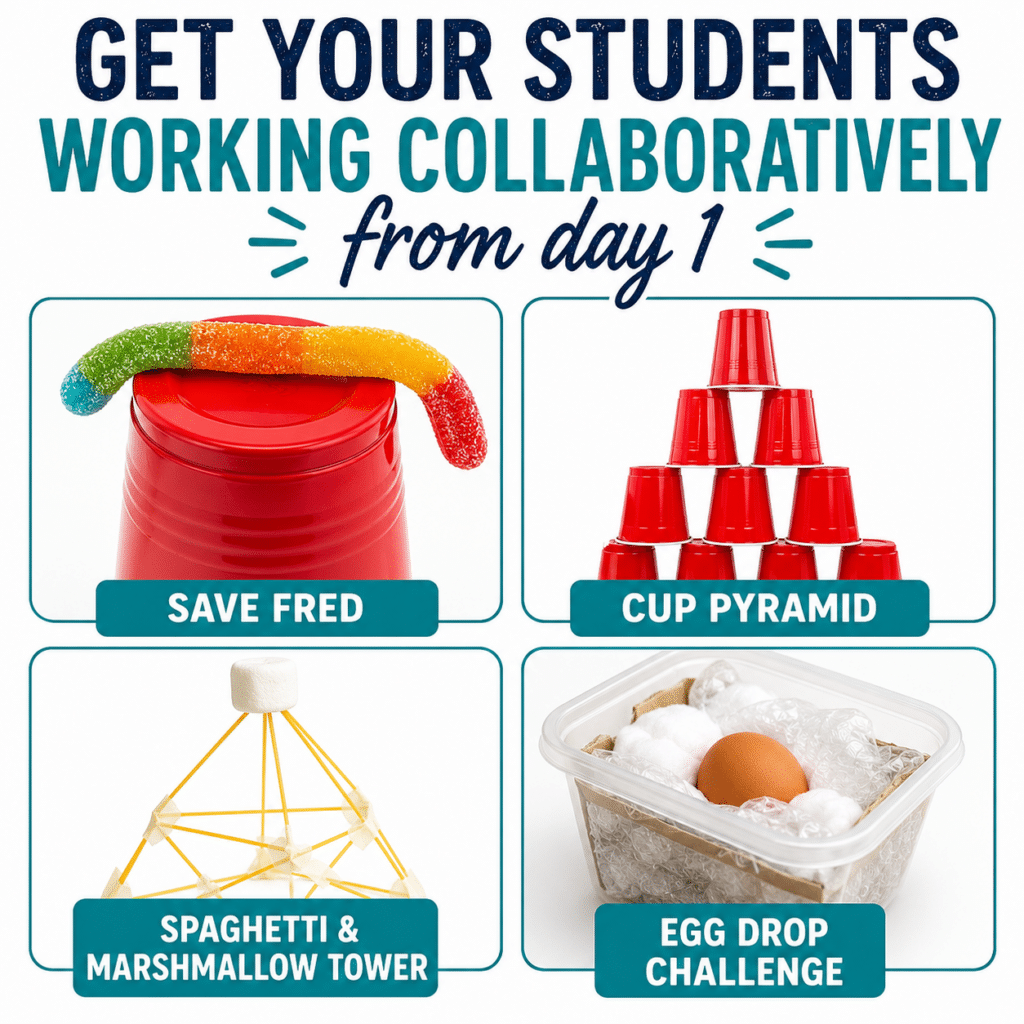
This is my go-to, and it’s the one kids still talk about in October. Fred is a gummy worm; his “boat” is an overturned plastic cup, and his “life preserver” is a gummy lifesaver underneath the cup. Using only four paper clips and no hands, the team has to get Fred onto the boat with the life preserver around him. It’s pure problem-solving and teamwork, and it forces the quiet kids and the loud kids to actually talk to each other. You can find this activity and others in my back-to-school team-building activities.
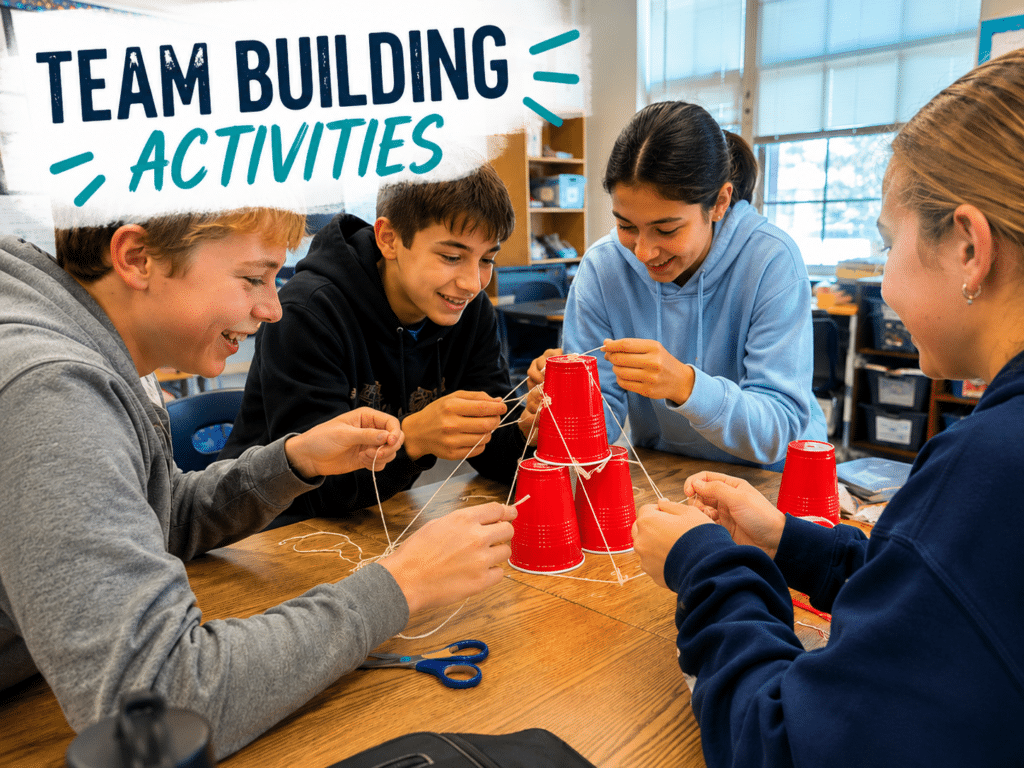
Give each group a single rubber band with four strings tied to it. No one is allowed to touch the cups with their hands. The only way to build the pyramid is to pull the strings together at the exact same time, which means they have to communicate or the whole thing collapses. It’s hilarious to watch, and it makes the point about teamwork better than any speech I could give. This is fun because you can give them different challenge levels, each one slightly more difficult. Sometimes I make it so that they can’t talk during the first 2-3 minutes. This teaches them to use other modes of communication. You definitely need to watch out for cheaters in this one, but it’s all in good fun. This is also found in my back-to-school team-building activities.
3. Solar oven s’mores
Early-year weather is hot, so use it. Groups build a simple solar oven out of a pizza box, foil, and plastic wrap, then race to melt a s’more. You get teamwork plus a real conversation about heat and energy transfer, and everyone gets a snack out of it. NASA Climate Kids has a kid-friendly solar oven guide if you want a ready reference for students. If your school does pizza lunches like ours does you can grab those pizza boxes. That’s what I do.
4. Marshmallow and spaghetti tower
Twenty sticks of spaghetti, a yard of tape, a yard of string, and one marshmallow that has to sit on top. Tallest free-standing tower wins. It’s engineering and iteration under real time pressure, and it teaches kids to test and fail fast. There’s a great backstory on why this challenge works so well in Tom Wujec’s TED Talk on the marshmallow challenge. I like to offer candy to the group that can build the tallest tower.
5. Egg Drop
The classic for a reason. Groups design a container to keep a raw egg from cracking on a drop, working inside whatever material constraints you set. They are doing the engineering design process. It builds in productive failure, and the cleanup is worth it. The one I do with my students has them thinking like scientists as they take on different roles like packaging engineer, aerospace engineer, and structural engineer. They have to learn about their scientists and how they would use their knowledge to protect the egg. You can find it here:
6. Mystery box observations
Put two or three objects in a sealed box (a pencil, a paper clip, an eraser, a rubber band) and have teams figure out what’s inside using only observation. No peeking. They shake it, tilt it, listen, and build a claim from evidence. It’s the purest practice of real scientific observation, and it’s a sneaky early intro to inference. This can also be used as a fun introduction to claim, evidence, and reasoning.
7. Create a Scientist
Have each student draw what they think a scientist looks like, then put the drawings up and debrief together. Almost every year, the boards fill with wild hair, lab coats, and beakers. That’s the opening to talk about who actually does science and to push back on the stereotypes, so every kid in the room can start seeing themselves as a scientist on day one. Then you can have them go into Canva and use their magic media tool to create themselves as a scientist.
8. Group “What is science?” mind map
Give each group a big sheet and have them map everything they think science is. It surfaces what they already believe, gives you a read on the room, and sets the tone that in here, their thinking matters. It’s low prep, and it tells you more about your students than any first-day survey.
Turn the fun into routines that stick.
The trap with first-week activities is that the energy fades by week three. The fix is to connect the play to the systems you’ll run all year. The collaboration from Save Fred becomes your lab-group norms. The observation skill from the mystery box becomes your daily warm-up. The “what is science?” thinking becomes the backbone of how you talk about evidence.
That’s how I bridge week one into the rest of the year, and it’s why these activities are worth more than a fun afternoon.
Start the year as a team.
You don’t have to choose between building community and teaching science. Pick two or three of these, run them in the first week, and you’ll spend the rest of the year with a class that already knows how to work together and take a risk. This is also a great way for you to see who works well together and who would be better off being separated. Change up the groups for each activity. Let them sometimes choose. By the end of the week, you will have an idea of what your seating chart should look like moving forward.
Pin this post so it’s waiting for you next August, and check out my warm-up routine for an easy way to keep that team energy going every single morning.