
I have always been a fan of teaching the scientific method. Plus, knowing food was the key to my students’ hearts, still is, I loved using candy to help them learn about the scientific method.
Fast forward 28 years, and that is still what I am doing. However, I have now expanded it to have them prove commercial claims, do some fun basic activities where they learn how to write procedures, and more. With the NGSS standards, I am now incorporating the 5E model for my units. So, this is how I now teach the scientific method using the 5E lesson model.
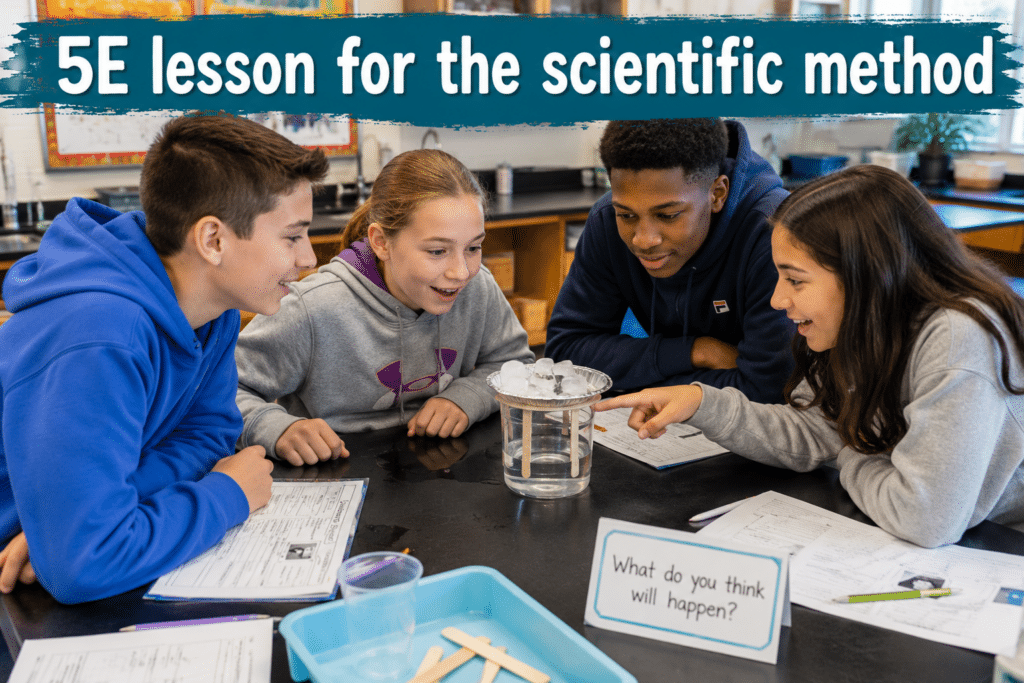
What the 5E model is
The 5E model breaks a unit into five phases: Engage, Explore, Explain, Elaborate, and Evaluate. Students become curious, investigate a phenomenon, learn the science behind what they observed, apply their new understanding, and finally demonstrate what they’ve learned. While the 5E model works for any science topic, it’s especially effective for teaching the scientific method because students learn by doing science, not just memorizing the steps. Like the engineering design process, the scientific method is a foundational skill that students will use throughout their science education and their lives.
Why I teach the scientific method this way
When you teach the steps as a one-and-done lesson, students nod, pass the quiz, and three weeks later can’t tell a hypothesis from a conclusion. It didn’t stick because they only did it once. The 5E model fixes that by spreading the method across a whole unit. Students observe, question, predict, test, and explain over and over with different activities, so the method becomes a habit instead of a definition. That habit is the foundation on which everything else this year gets built.
Here are the key parts of the 5E lesson design:
1. Engage: hook them with a quick investigation
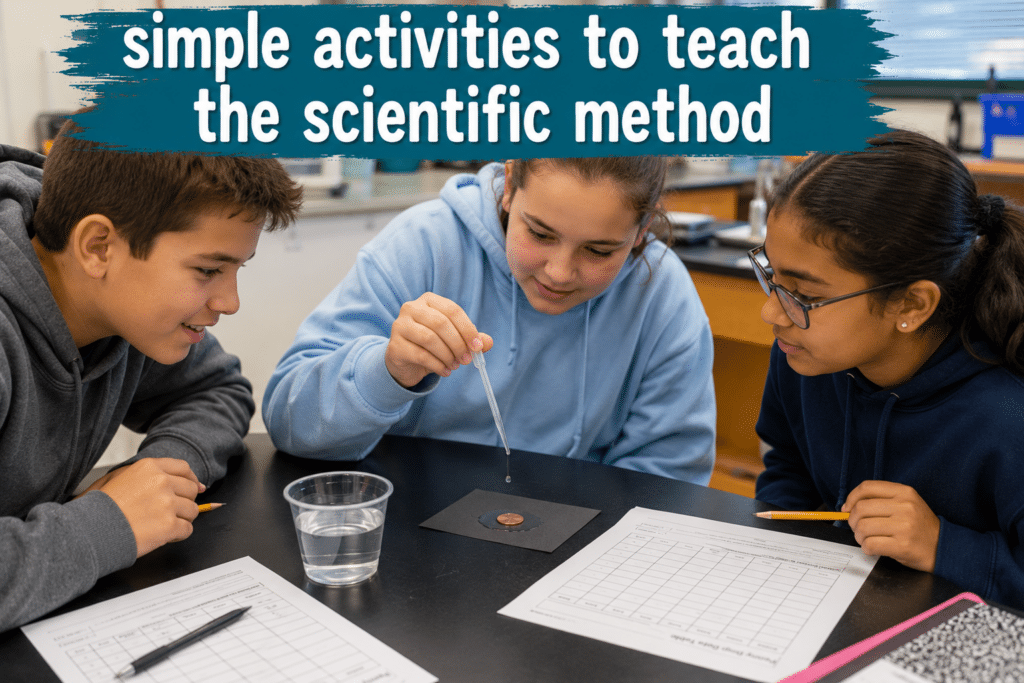
The first day is about curiosity, not vocabulary. I open with a fast, whole-class investigation like Drops on a Penny, where students predict how many drops of water will fit on a penny and then test it. They’re surprised, they argue about why, and they start asking their own questions without realizing they’ve already begun the scientific method. That’s the whole goal of Engage: get them wondering so they want to investigate.
2. Explore: let them run the method before you name it
The exploration phase is always my favorite. It’s messy, and they are figuring things out through observations, trial and error. They are making their own assumptions and coming up with their own ideas before they know what things are. For the scientific method, I’ll use one of my candy labs, where students observe the candy, ask a question, make a prediction, test it, and draw a conclusion, all with something they actually want to touch. From there, we move into science stations, so students hit the method from a few different angles: an online simulation, a hands-on group experiment, and a teacher-led investigation for the students who need more support. Some years, I also have them design their own experiment as a scientific method inquiry investigation. They don’t have the perfect vocabulary yet, and that’s fine. They’re doing the method, which is exactly what makes the vocabulary stick when it comes.
3. Explain: name the steps they just lived
Now that students have explored the scientific method process on their own, it’s time to put words to the different parts of the process they did. This is where I introduce the actual terms, independent and dependent variables, controls, hypothesis, and controlled experiment. I usually do this with a short flipped lesson, a video with a note-taking template, and a quick quiz they can do at home, so we save class time for the hands-on work. If you’d rather keep it in class, a set of science readings on the scientific method, controls and variables, and accuracy versus precision does the same job. Either way, the key is that Explain comes after Explore, not before. They’re labeling an experience they already had.
4. Elaborate: stretch the skill with a new challenge
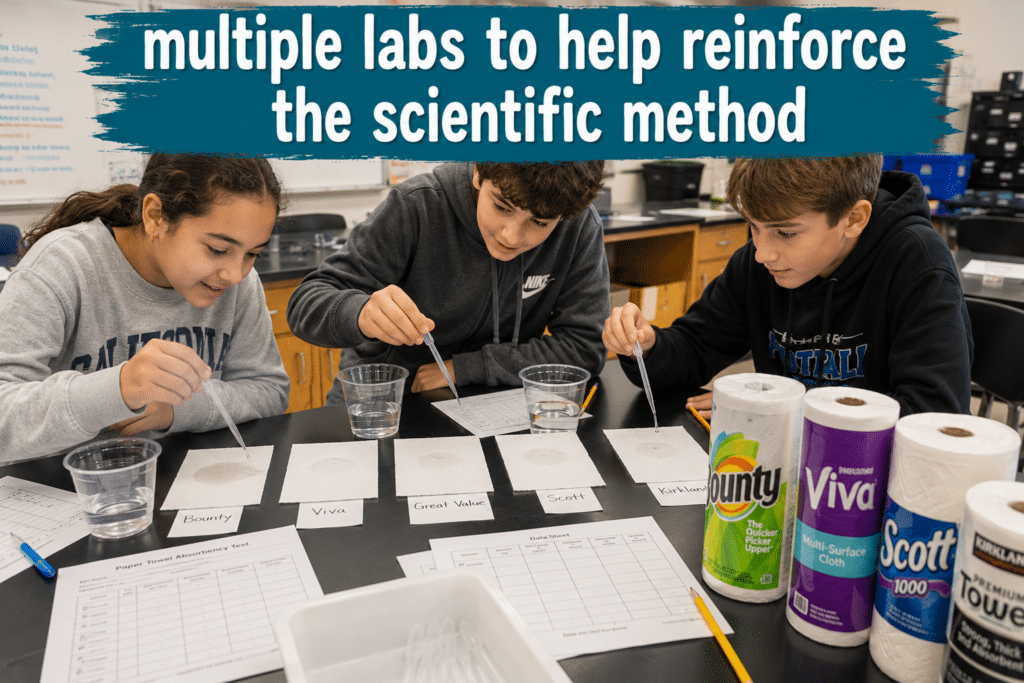
Once students know the terms, I push them to use them in a trickier setup. My go-to here is the paper towel lab, where a brand claims it’s “more absorbent” and students have to design a fair test to find out if the commercial is telling the truth. It forces them to control their variables on purpose, not by accident, and it ties science straight to the ads they scroll past every day. It also teaches them not to believe everything they see on TV or, in their case, TikTok. I’ll also run another candy lab or a digital interactive notebook to keep the practice going. This is the phase where the method goes from “I can do it with help” to “I can do it on my own.”
5. Evaluate: let them prove it
For the assessment, I like to give students a choice for their performance assessment part. They can run one of the candy labs as a performance task or design and carry out their own scientific-method inquiry investigation. Then they also take a scientific method quiz just so I know they actually understand the vocabulary and the different parts. It’s one thing to know the vocabulary; it’s another to actually do the science.
The whole unit, already built
If piecing all five phases together sounds like a lot, that’s exactly why I built my Scientific Method 5E lesson. It has the engage hook, the labs, the stations, the flipped videos and readings, the practice, and the assessments, all sequenced in the 5E order, so you can teach the whole unit without building it from scratch. You can also grab the pieces on their own if you just want to start with one phase.
Science is about doing, not memorizing.
When you teach the scientific method through the 5E model, students stop memorizing science and start doing it. They leave your class able to ask a question, test it, and back up what they found, which is a skill they’ll use long after they’ve forgotten the poster on the wall. If you want more ideas on teaching the scientific method, my 8 Cool Scientific Method Experiments post is a great place to start.
How do you kick off the scientific method in your room, with a lab, a demo, or something else? I’d love to hear what gets your students hooked.